Discover the reproductive cycle of wild macaws high in the Amazon canopy.
High in the Amazonian forest of Tambopata, where tree canopies sway between heavy rains and sunny days, the reproductive cycle of wild macaws unfolds silently but precisely. Thanks to the MacawCam from the Tambopata Macaw Project, this process is no longer invisible; it becomes a real-time learning experience.
For the first time, it is possible to closely follow the reproductive cycle of macaws by observing a pair of wild macaws from inside one of our artificial nests. What we see on screen is not only an intimate glimpse into wildlife life but also a collaborative effort of research, monitoring, and conservation work aimed at understanding and protecting these iconic birds of the Peruvian Amazon, in partnership with the Museum of Natural History at the National University of San Marcos and ProCiencia-CONCYTEC.
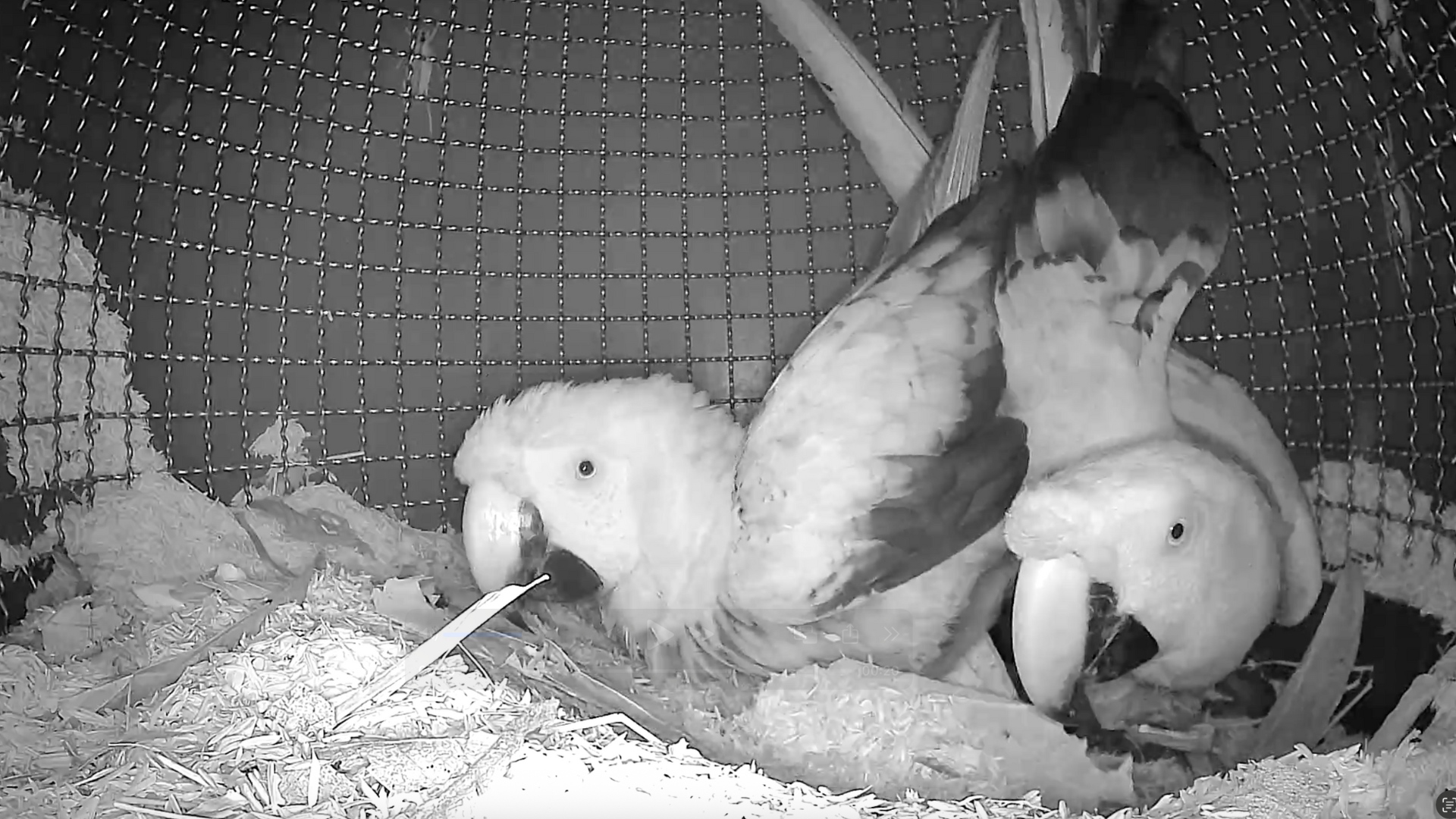
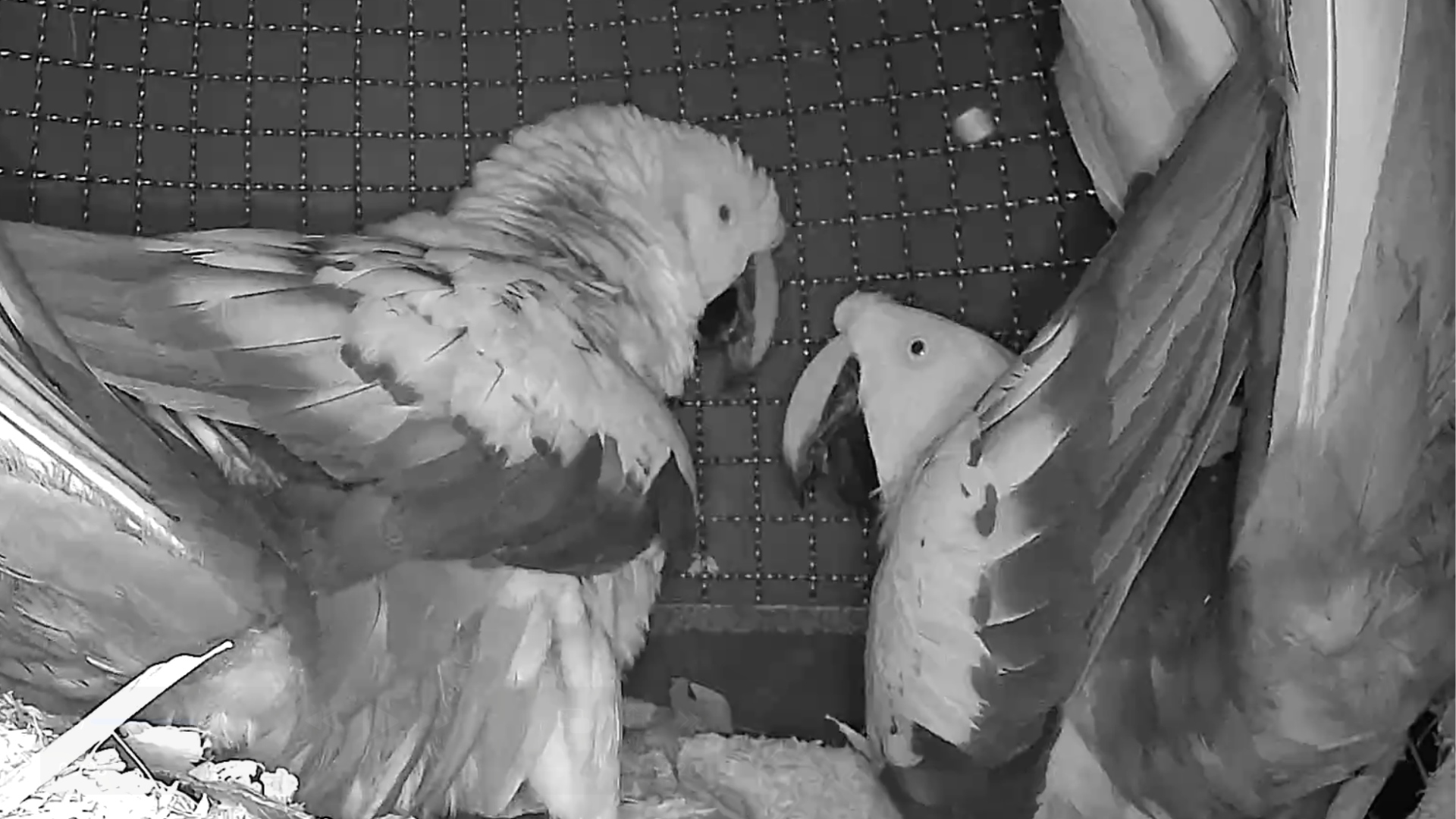
Scarlet Macaws (Ara macao) copulating in artificial nests of the Tambopata Macaw Project
Neotropical wild macaws of the genus Ara, such as Ara macao, follow a reproductive strategy very different from many other birds. While species like hummingbirds reach sexual maturity in just a few months and large raptors like harpy eagles take several years, macaws follow a slow life-history strategy: they mature late, can live for decades, and make a high parental investment in each reproductive attempt.
Within the reproductive cycle of macaws, nothing happens by chance. In the Tambopata National Reserve, reproduction typically begins between November and December, coinciding with the onset of the rainy season. This environmental synchronization is key, as it ensures that the period of highest energy demand, when chicks grow rapidly and are fully dependent on their parents, coincides with the peak productivity of the tropical forest. Young, A. M., Hobson, E. A., Bingaman Lackey, L., & Wright, T. F. (2012). Survival on the ark: Life‐history trends in captive parrots. Animal Conservation, 15(1), 28–43.
Ver esta publicación en Instagram
In wild macaws, there are no clear external morphological differences between males and females. Therefore, the success of their reproductive cycle depends on a sophisticated communication system. Signals such as dynamic facial blushing, feather erection, and eye pinning convey emotional states and strengthen the pair bond. These gestures are complemented by key behaviors such as mutual preening and ritualized food regurgitation, essential interactions for consolidating the bond and assessing parental compatibility in a species with such a high level of parental investment.
Bertin, A., Beraud, A., Lansade, L., Blache, M. C., Diot, A., Mulot, B., & Arnould, C. (2018). Facial display and blushing: Means of visual communication in blue-and-yellow macaws (Ara ararauna)? PLoS ONE, 13(8).
Copulation is one of the most critical and least documented moments in the macaw reproductive cycle. In the genus Ara, this act is notable for its exceptional duration, which can last between 8 and 12 minutes.
Performing it in the Amazon canopy is no easy task. Branches sway constantly, and balance is essential. To ensure cloacal contact, pairs of wild macaws adopt different positions, the most common being the classic dorsal mount and lateral copulation, where both individuals form an X to gain stability. During this process, rhythmic vocalizations play a crucial role: they help synchronize the pair and reinforce the exclusivity of the bond against potential competitors.
Romero-Herrada, J., Nycander, E., Díaz, B., Arana, C., & Salinas, L. (2026). Temporal Dynamics of Parental Behavior and Nest Use in Ara chloropterus and Ara macao at an Artificial Nest Box in Peru. Birds, 7(1), 9.
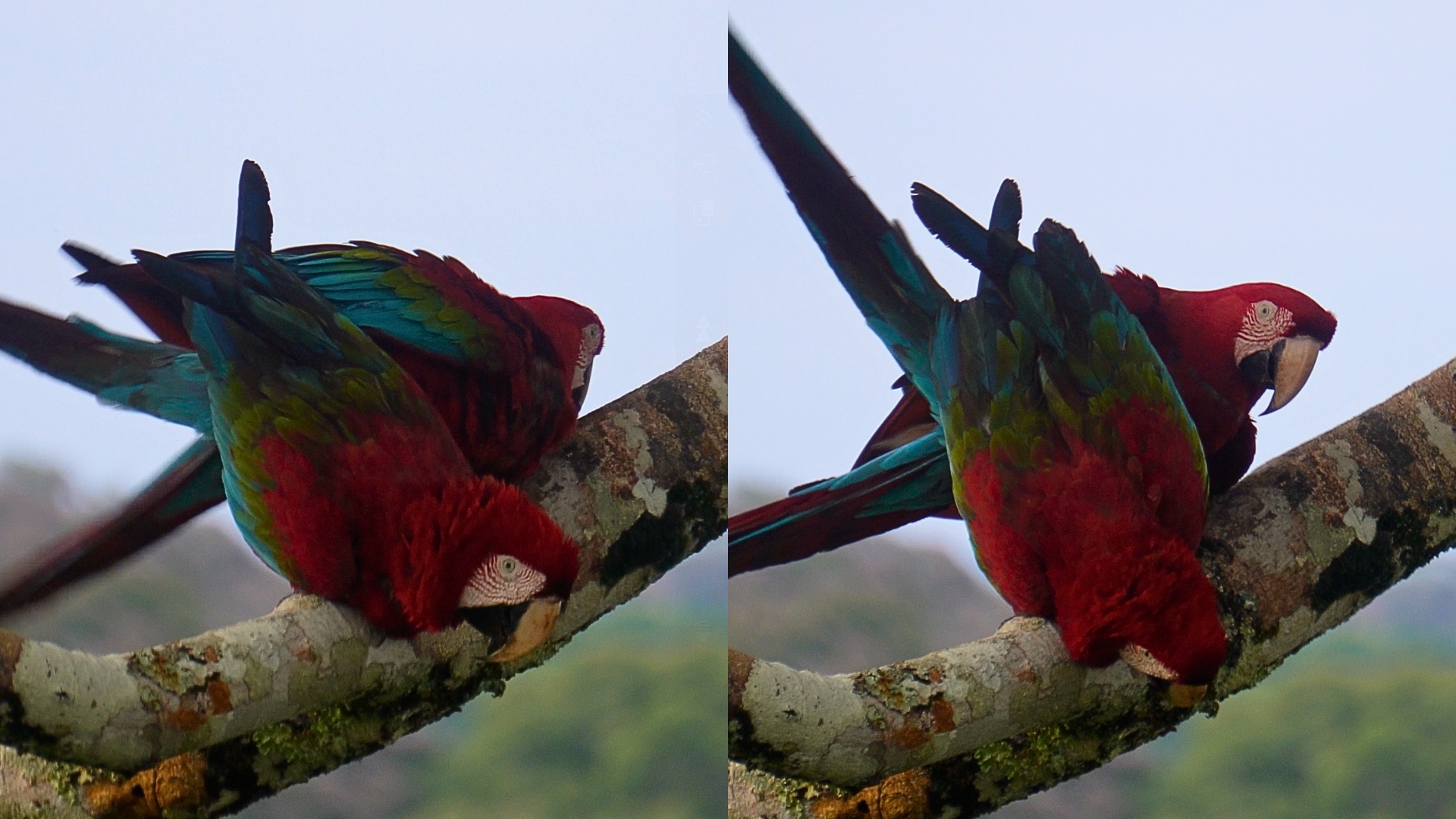
Ara chloropterus copulating high in the canopy of the Tambopata National Reserve, photos by Pedro Naveros
In the Tambopata National Reserve, one of the biggest challenges for wild macaws is not finding a mate, but securing a safe cavity for nesting. Competition for natural nests is high and has intensified with the loss of large trees in the Amazon. To support the reproductive cycle of macaws, the Tambopata Macaw Project has implemented PVC artificial nests that replicate natural conditions, increase reproductive opportunities, and allow for non-invasive scientific monitoring. Pairs constantly guard these nests, a key behavior for reproductive success that we can now observe thanks to camera traps and MacawCam.
Vaughan, C., Nemeth, N., & Marineros, L. (2003). Ecology and Management of Natural and Artificial Scarlet Macaw (Ara macao) Nest Cavities in Costa Rica. Ornitología Neotropical, 14(3), 9.
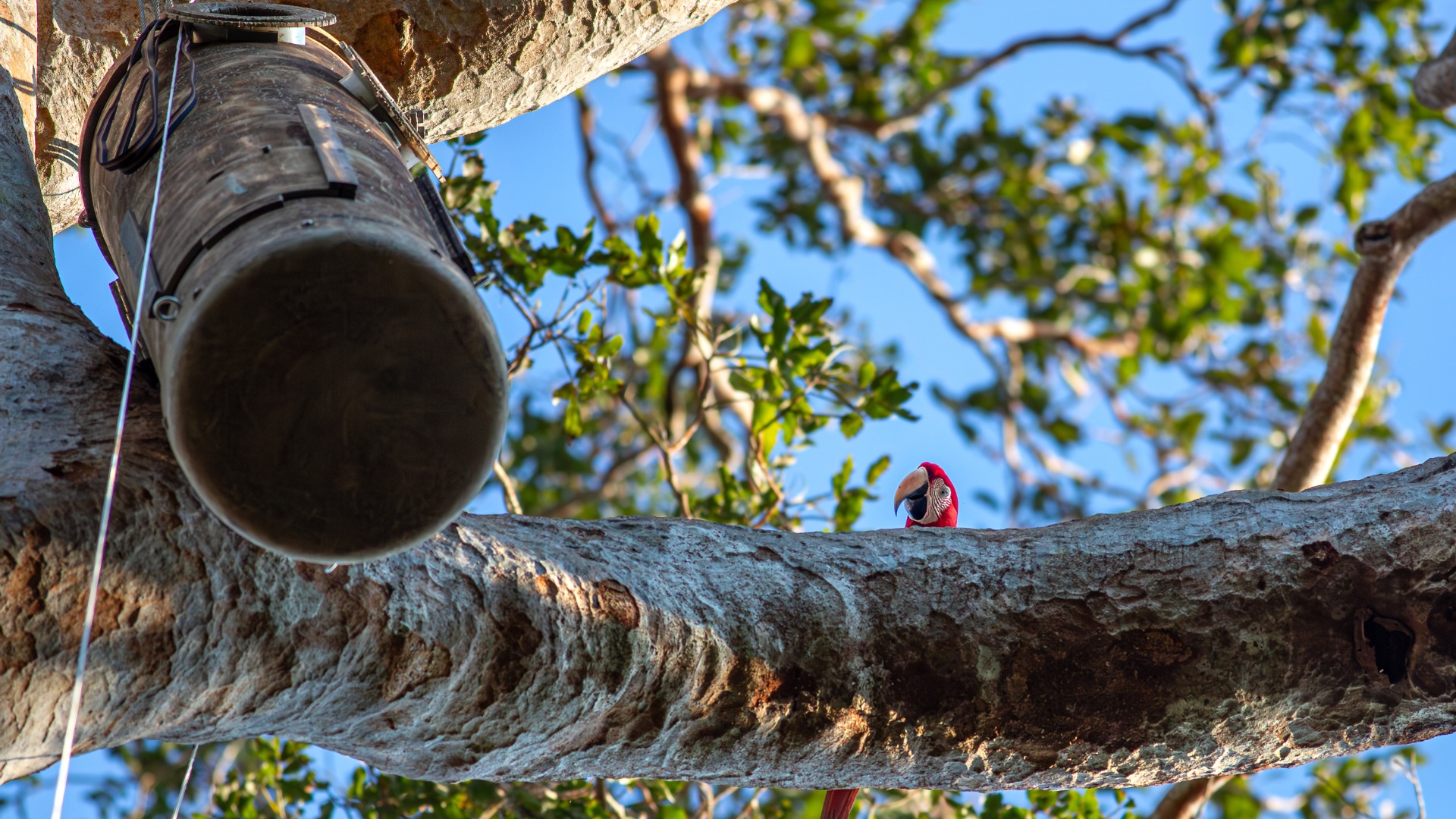
PVC artificial nest of the Tambopata Macaw Project in the Tambopata National Reserve, Photo by Jonah Darius
MacawCam is much more than a camera. It is an educational, scientific, and conservation tool that allows us to observe the macaw reproductive cycle without interfering, learn without disrupting natural processes, and bring the Amazon rainforest of Tambopata closer to people around the world.
Every behavior we witness, from copulation to incubation and chick growth, reminds us that conservation happens concretely: nest by nest, pair by pair, and generation by generation. Understanding the life cycle of wild macaws also means understanding why protecting these natural processes is fundamental for the future of the Amazon.
By Jaemy Romero, scientific coordinator of the Tambopata Macaw Project
In Alliance with: