
In the forests of Tambopata, observing a troop of brown capuchins (Cebus apella) means encountering one of the Amazon’s most versatile primates. They move between the understory and canopy, constantly explore their surroundings, search for different food sources, and maintain complex social relationships.
The brown capuchin is a primate widely distributed throughout the Amazon and is known for its ecological flexibility and exploratory behavior. Its diet includes fruits, seeds, insects, and other small animal resources, allowing it to take advantage of a wide variety of resources available in the forest.
But observing these primates reveals only part of their behavior.
To better understand how they move, interact, and communicate, researchers from the 8 Primates Project, based at the Tambopata Research Center, combine behavioral observation with bioacoustic monitoring.
Rather than simply observing primates when they appear in front of researchers, the project also seeks to listen to their vocalizations and turn these sounds into data that can help us better understand their ecology and behavior.
The brown capuchin belongs to the Cebidae family and is part of the group of robust capuchins in the genus Sapajus.
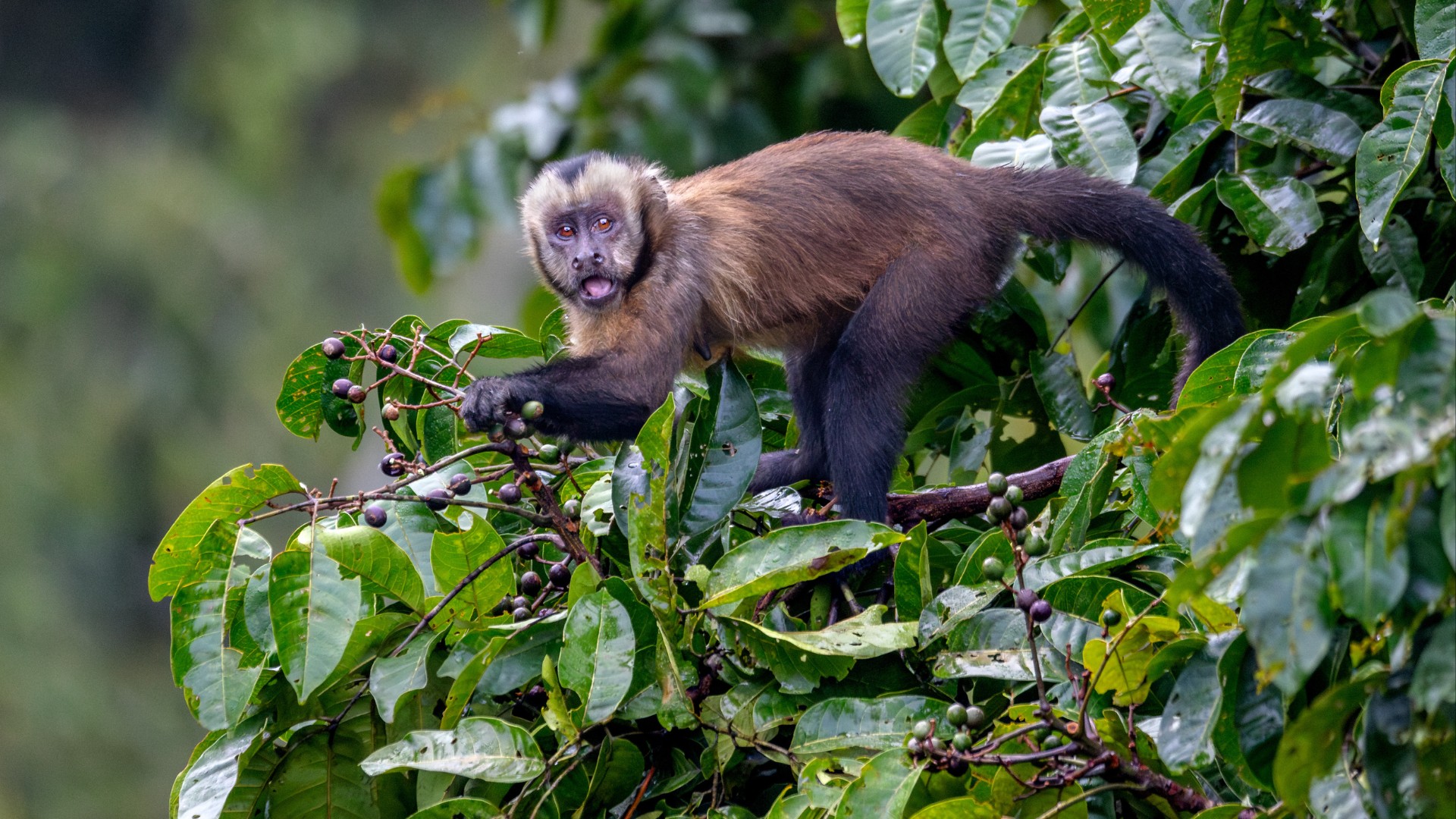
Brown Capuchin Monkey eating on a branch. Photo by Jonah Darius
Its diet is omnivorous and opportunistic. Depending on resource availability, it may consume fruits, seeds, invertebrates, and small vertebrates. This flexibility allows it to adapt its foraging strategies to changing environmental conditions and thrive in the dynamic environment of the Amazon rainforest.
Capuchins are also known for their cognitive abilities and complex social interactions. Tool use associated with obtaining and processing food has been documented in different species of the genus Sapajus. However, the abilities of these primates are not limited to tool use. Their capacity for learning, exploration, problem-solving, and social interaction makes capuchins a particularly interesting group for the study of animal behavior.
And there is another dimension of their behavior that is especially important to researchers: communication.
Living in a group requires the exchange of information.
Primates use visual signals, postures, behaviors, and vocalizations to interact with one another. In social species such as the brown capuchin, studying these signals can help us understand how individuals relate to one another and how life within the group is organized.
But studying this communication in the forest is not easy.
Dense vegetation can conceal animals even when they are relatively close. A researcher may hear a vocalization without immediately being able to identify which individual produced it or locate the group visually.
This is where technology can expand what our senses are able to detect.
Bioacoustics allows researchers to record and analyze sounds produced by animals. In primates, these recordings provide a way to study their vocalizations and complement direct observations of their behavior.
At the 8 Primates Project, researchers combine behavioral tracking with bioacoustics to study the movement and communication patterns of the eight primate species found in Tambopata.

Tambopata Research Center Guests participating in the 8 Primates Project. Photo by Carlos Gonzales
The project is developing extensive call libraries for these species. These libraries bring together and organize the different sounds recorded in the field, creating a database that can be used for future research and monitoring systems.
Every audio file represents a small window into life in the forest.
By collecting recordings over extended periods, researchers can study when and where particular vocalizations occur, compare them with behavioral observations, and look for patterns that can help us better understand primate communication. Rather than relying exclusively on visual sightings, their vocalizations can become a complementary signal for detecting their presence and tracking their movement patterns.
This approach is particularly valuable in tropical forests, where dense vegetation can make visual monitoring difficult.
Listening to a primate does not simply mean identifying a sound.
To study a vocalization scientifically, it is necessary to analyze it within its context. Researchers can observe who produces the sound, when it occurs, where the group is located, and what behavior is taking place at that moment.
For this reason, bioacoustic research is complemented by behavioral tracking of primate groups.

Pair of brown capuchin monkeys. Photo by Jonah Darius
A single recording can provide limited information. But when it is combined with field observations and a large number of recordings, researchers can begin to identify patterns in vocal characteristics and establish relationships with specific behavioral contexts.
This process turns a recording into something much more valuable: data that can be scientifically analyzed.
As the number of available recordings increases, researchers can compare vocalizations across individuals, species, locations, and different times. Over time, this information contributes to a more complete picture of primate communication and ecology in Tambopata.
One of the most promising aspects of bioacoustic research is the possibility of automating part of the analysis.
Processing large amounts of recordings manually requires an enormous amount of time. Artificial intelligence and machine learning tools can help identify specific acoustic patterns within large volumes of data.
But for these systems to work effectively, researchers first need well-identified and contextualized recordings. That is why building a robust acoustic library is such an important step.
The more sounds that are accurately recorded and classified, the greater the potential to develop tools capable of automatically recognizing specific vocalizations and using them to detect the presence of primates. In the future, these technologies could make it easier to monitor species across larger areas and over longer periods.
Technology, therefore, does not replace fieldwork. It expands it.
Bioacoustics offers a different perspective for studying biodiversity.
A recording system can capture sounds over long periods, even when researchers are not present. This makes it possible to gather information about species’ vocalizations and movement patterns at a temporal and spatial scale that would be difficult to achieve through direct observation alone.
For primates, acoustic recordings can help investigate:
This information can complement other methods used to study Amazonian biodiversity.
In an ecosystem as complex as Tambopata, no single method can provide a complete picture. Combining behavioral observation, bioacoustics, technology, and citizen science allows researchers to build an increasingly detailed understanding of primate communities.
Studying the brown capuchin is not simply about discovering what sounds it produces.
Every recording contributes to a better understanding of how primates move, interact, and use their environment.
Bioacoustics can become a particularly useful tool for this purpose. By developing vocalization libraries for the eight primate species of Tambopata, researchers are creating a foundation that can help detect these species and expand primate monitoring to other forests across Peru.
The 8 Primates Project, led by Dr. Mark Bowler, combines behavioral research, bioacoustics, technology, and citizen science to study the primates of Tambopata.
The process begins with something as simple as listening. Then come the questions, recordings, observations, analysis, and interpretation.
And every new piece of data contributes to a deeper understanding of the primates that inhabit the forests of Tambopata. Because to conserve biodiversity, we first need to understand it.
And to understand some of the Amazon’s most elusive inhabitants, we first need to learn how to listen.
