The Tambopata Macaw Project marks a major milestone for science and conservation in Peru with the publication of the scientific article “Temporal Dynamics of Parental Behavior and Nest Use in Ara chloropterus and Ara macao at an Artificial Nest Box in Peru.” This is the first study conducted in the country and only the second worldwide to document, through continuous monitoring, the parental behavior of the red-and-green macaw (Ara chloropterus) under wild conditions.
This scientific study of macaws in the Peruvian Amazon represents a key advancement in understanding the reproductive biology of these iconic species. Conducted in the Tambopata National Reserve, the research transformed months of audiovisual records into scientific evidence to analyze how macaws ensure reproductive success in an environment where natural nesting cavities are increasingly scarce due to the loss of key tree species. Documenting parental behavior in wild macaws under natural conditions provides crucial insight into the factors that determine their survival.
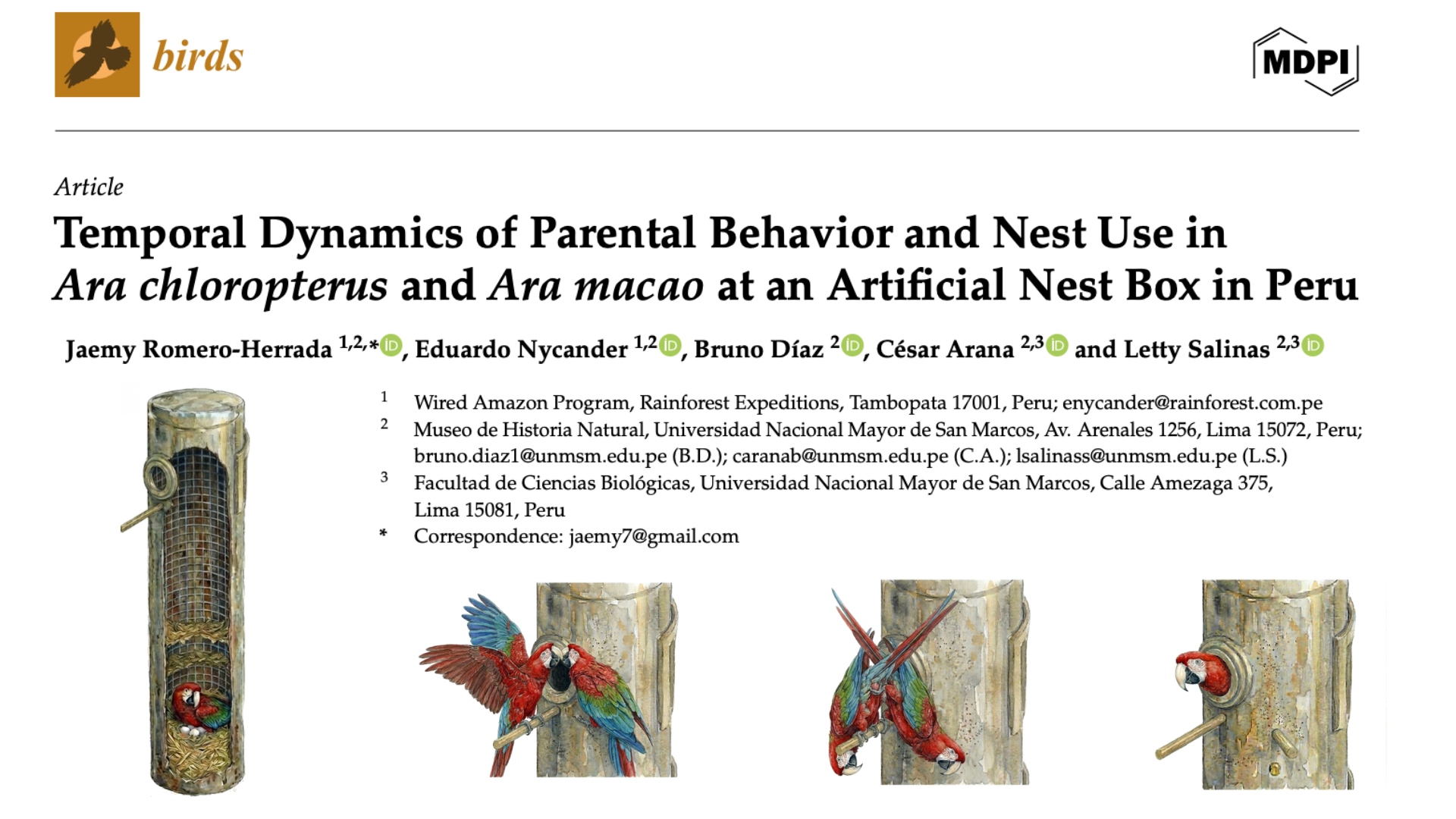
Image taken from the scientific study: Temporal Dynamics of Parental Behavior and Nest Use in Ara chloropterus and Ara macao at an Artificial Nest Box in Peru
The research began in August 2023 with the installation of a first-generation artificial nest, designed using double-walled PVC and a clay lining to replicate the thermal insulation and microclimate of a natural cavity. The nest was placed 30 meters high in an emergent Dipteryx charapilla tree, a species essential for the nesting of Amazonian macaws.
To monitor activity without disturbing natural behavior, smart Netvue Birdfy cameras equipped with motion sensors were installed to automatically record every visit to the nest. This system enabled continuous documentation of parental behavior in wild macaws, from initial nest occupation to the development of a fledgling ready to leave the nest.
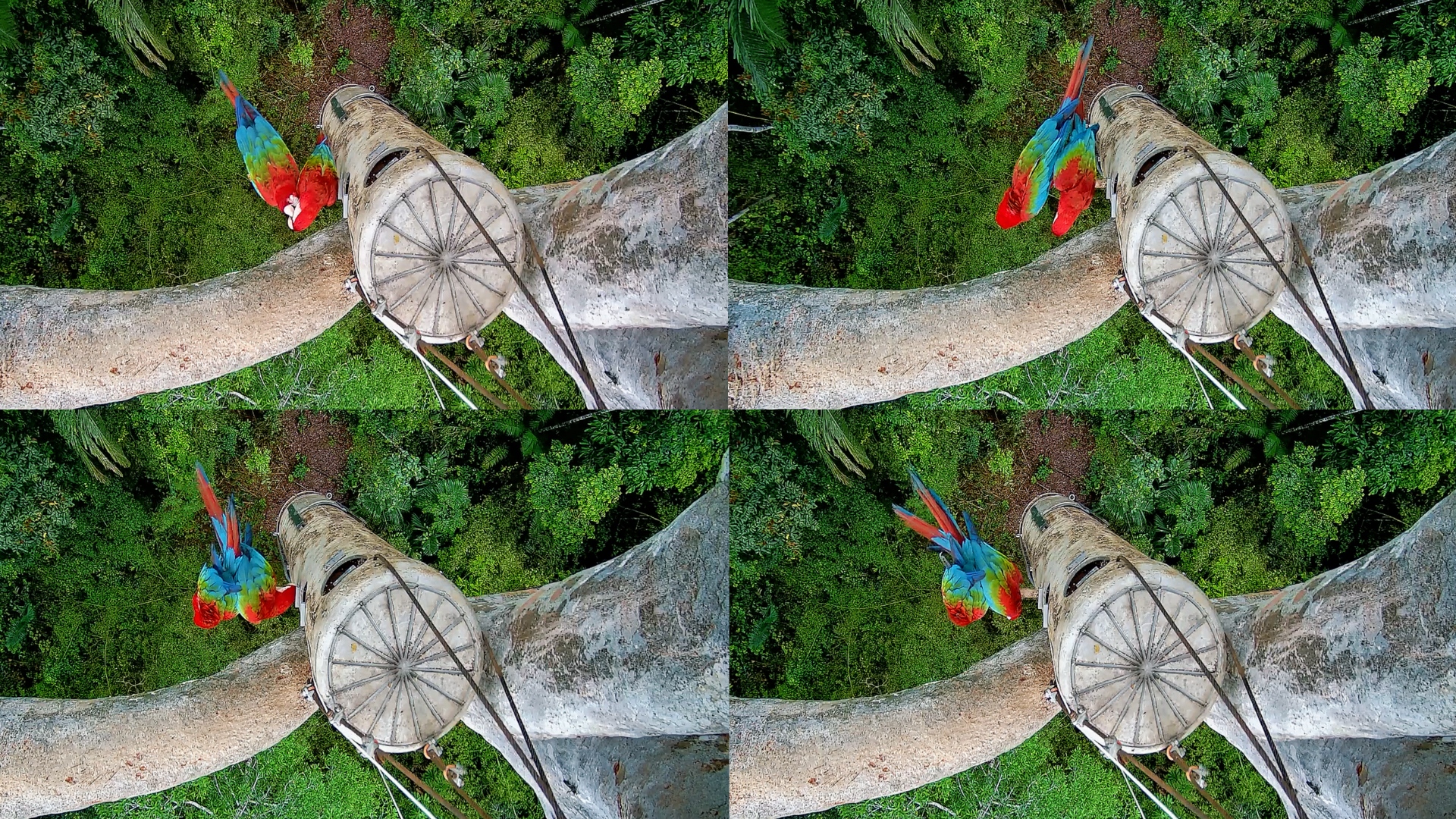
Red and green macaw in an artificial nest of the Tambopata Macaw Project
The large volume of data collected was analyzed by researchers from the Museo de Historia Natural de la Universidad Nacional Mayor de San Marcos using BORIS (Behavioral Observation Research Interactive Software). This scientific tool transforms behavioral observations into quantifiable data.
Each video clip was reviewed to identify individuals, measure the duration of specific actions, and classify behaviors within a catalog of 17 behavioral categories, including vigilance, nest attendance, and mutual grooming (allopreening). Generalized Additive Models (GAMs) were subsequently applied to interpret behavioral changes throughout the reproductive cycle.
The analysis revealed that vigilance and nest attendance peak immediately after the chick hatches, demonstrating how parental behavior in wild macaws reorganizes to maximize offspring survival.
The study also enabled interspecific behavioral comparisons. The red-and-green macaw (Ara chloropterus), as the primary nest occupant, maintained consistent investment in vigilance and parental care. In contrast, the scarlet macaw (Ara macao) exhibited sporadic visits that decreased as the breeding season progressed. These findings confirm that reproductive success depends on a complete reorganization of parental behavior to protect the nest and ensure chick development.
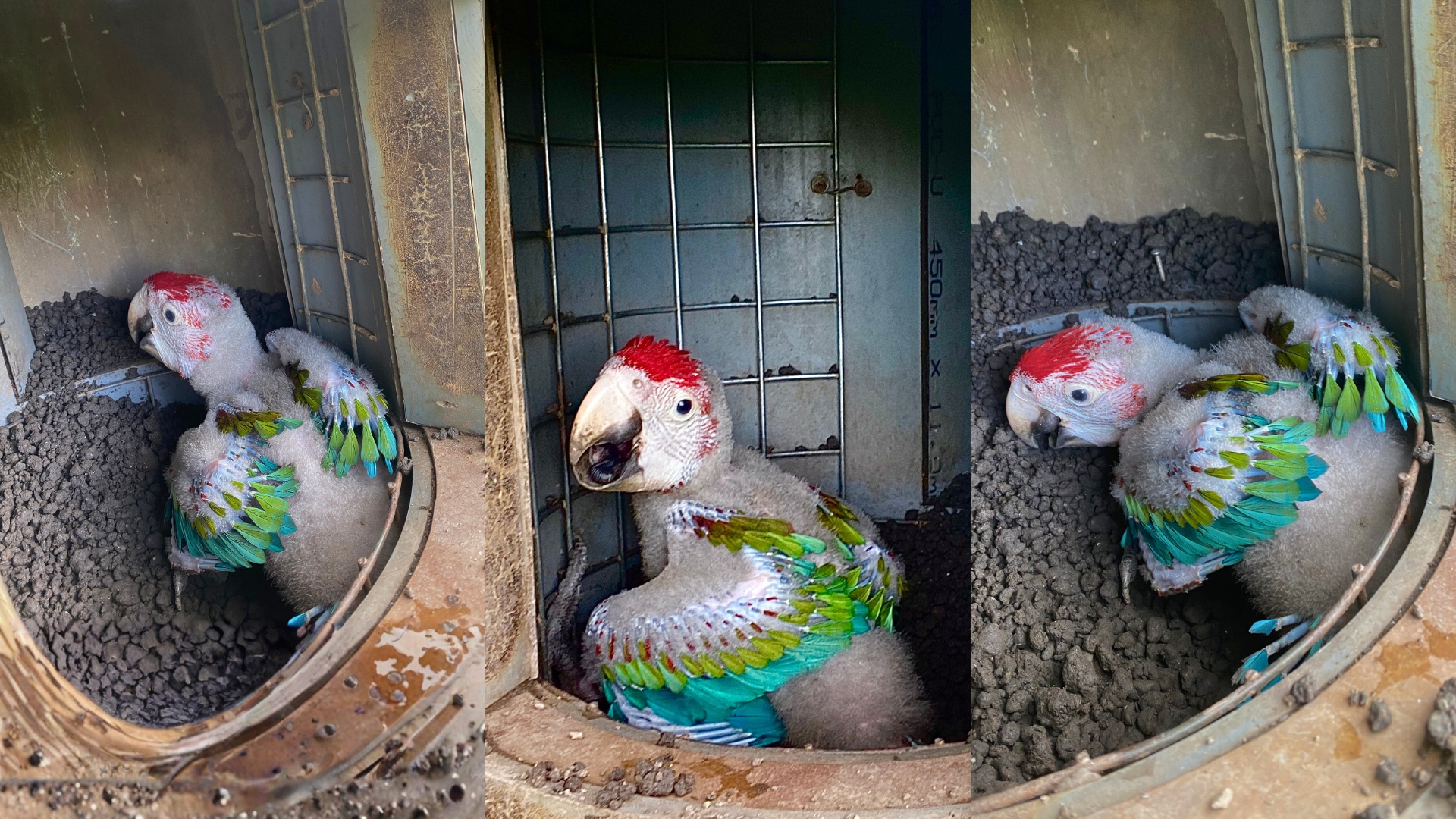
Red and green Macaw chick inside of an artificial nest
This scientific study of macaws in the Amazon demonstrates that artificial nests, combined with scientific monitoring and non-invasive technology, can serve as effective conservation tools in the face of natural cavity loss.
This work was made possible thanks to the Wired Amazon team, Rainforest Expeditions, Museo de Historia Natural UNMSM, Universidad Nacional Mayor de San Marcos, with funding from the Gordon and Betty Moore Foundation, the UNMSM Vice-Rectorate for Research, and CONCYTEC through PROCIENCIA.
Understanding the science behind macaw reproduction is a fundamental step toward protecting the biodiversity of the Peruvian Amazon.