
If there’s a group of insects that truly embodies the spirit of The Tiny Things That Run the World, it’s treehoppers. Here in the Peruvian Amazon, especially deep in the Tambopata Rainforest, treehoppers are everywhere tiny, bizarre, and brilliant. These creatures—some with helmets shaped like thorns, dragons, or even miniature dinosaurs—look like characters that escaped from a fantasy novel. But their real magic isn’t their looks.
It’s their voice.
A voice we can’t hear.
So… how do treehoppers communicate?
Not through buzzing.
Not through chirping.
Not through anything that travels through the air.
Treehoppers speak through vibrations.
They vibrate their abdomens, sending tremors through their legs and into the stems of the plants they live on. Those vibrations travel like secret messages through the plant’s tissues. And other treehoppers, waiting silently nearby, pick up the signal through tiny sensors in their legs.
It’s like they’re texting—but using the plant as the Wi-Fi.
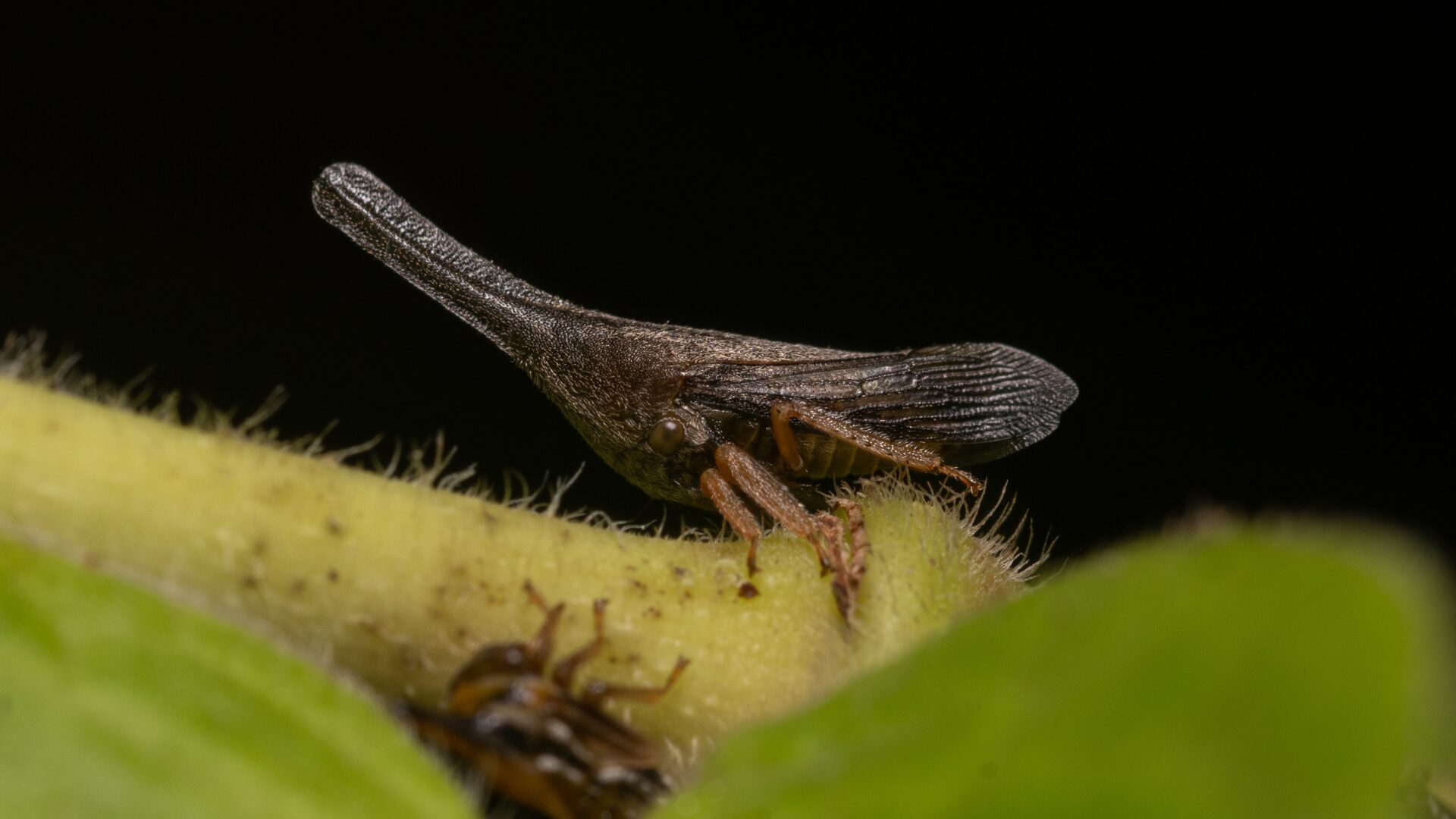
Enchenopa sericea in a leaf. Photo by Gabriel Serrano
Mating:
Males vibrate to attract females. In many species found in the Peruvian Amazon (Enchenopa sericea being seen at the Tambopata Research Center), they sing back and forth in what scientists call duets. The male sends a message, the female responds, and he follows her reply through the plant like a breadcrumb trail.
Cooperation:
Young treehoppers of species like Calloconophora pinguis, commonly observed in the Tambopata Rainforest, send vibrations to gather their siblings and move together toward fresh, tasty leaves.
Warning of predators:
Some mothers guard their babies. When the little ones feel threatened, they vibrate to send an alarm. The mother responds with her own signal—her way of saying, “I’m coming.”
Thanks to the creativity of scientists like Cockcroft—and ongoing research boosted by programs such as Wired Amazon—we can now translate these vibrations into sounds humans can perceive, even though they are naturally inaudible to us.
What he hears are buzzes, growls, and intimate melodies that exist only in the world of stems.
In some experiments, males searching for mates walk along a stem, stop, emit a signal, and wait for the female’s reply. Depending on how she responds, they decide whether to keep moving forward or turn back.
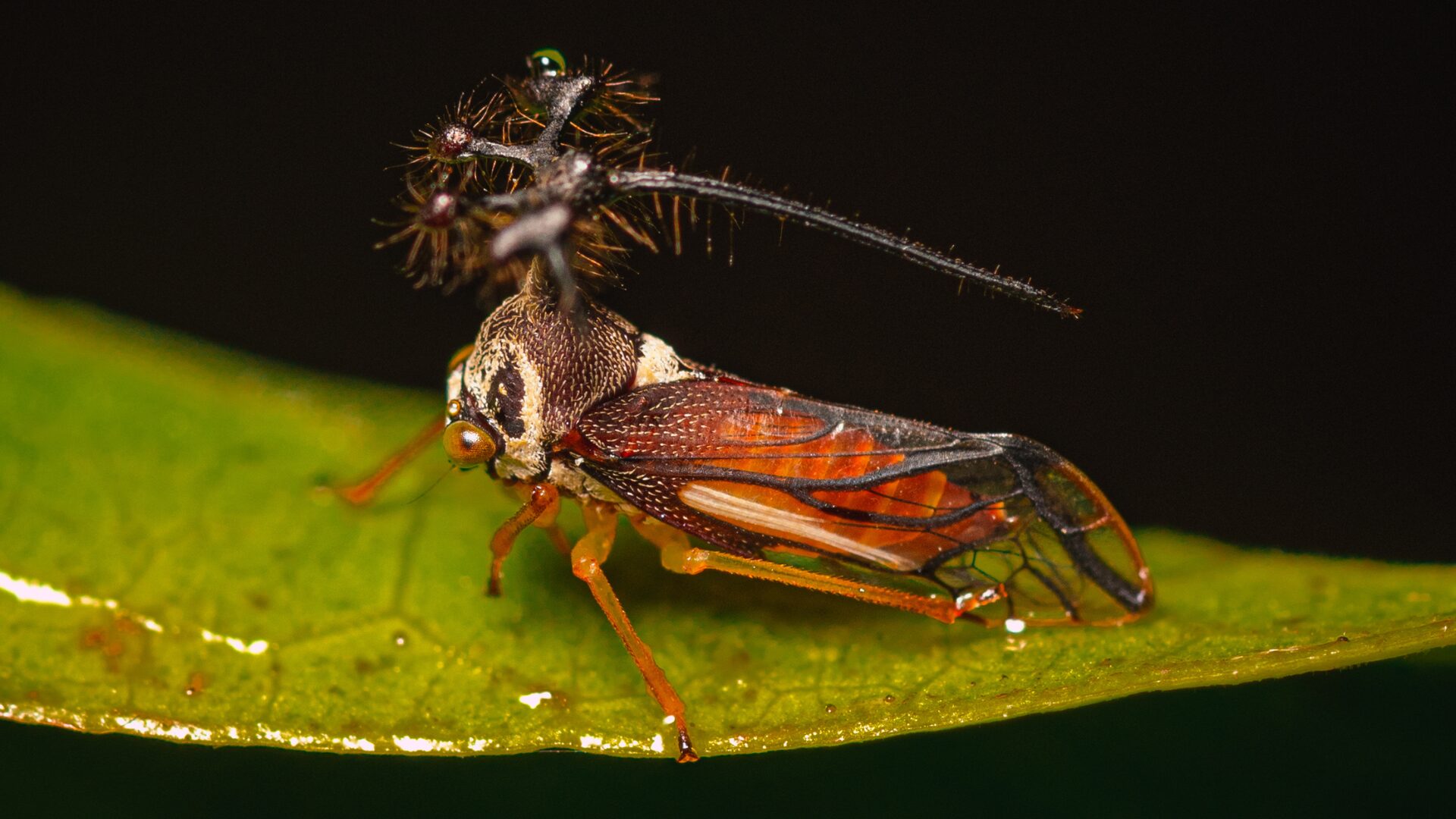
Bocydium globulare in a leaf. Photo by Gabriel Serrano
Not every plant makes communication easy
Vibrations can get distorted depending on the plant:
Thick stems, thin stems, woody stems, watery stems—they all change how signals travel. Over millions of years, each treehopper species has fine-tuned its “messages” to the specific plants it lives on.
It’s evolution working like a sound engineer.
Because they remind us that nature communicates in ways we often overlook.
While we look for sound, light, or color… the forests of the Peruvian Amazon are carrying full conversations right under our noses.
Understanding treehoppers helps scientists decipher insect social behavior, including courtship, teamwork, and parental care. And there’s even a practical side: someday we might control agricultural pests by interrupting their vibrational signals.
Next time you’re walking through the Tambopata Rainforest and see a plant stem covered in tiny, odd-shaped insects, pause for a second.
Even if you don’t hear anything, the plant might be resonating with entire conversations: warnings, love songs, dinner invitations—messages pulsing through the forest floor of the Peruvian Amazon Tambopata ecosystem.
The world of treehoppers is proof that the smallest beings often hold the most extraordinary secrets, exactly the kind of stories we explore here at THE TINY THINGS THAT RUN THE WORLD.
